Friday, May 31, 2024

1908 Honolulu League: The Saints stumble

In this post I'll give a game-by-game account of the 1908 Honolulu League and recount some of its statistics at the end, just as I did for the 1907 Honolulu League. 

A little information about the league: The Honolulu League consisted of four teams; three, the St. Louis Saints, Kamehameha, Punahou, were alumni teams of Honolulu prep schools. The fourth was Diamond Head, an athletic club, nicknamed the Jewels. The league played doubleheaders every Saturday at the League Grounds in Honolulu. Its season was typically divided into two nine-game halves. 

The 1908 Honolulu League opened its season May 3rd. The great star Barney Joy was back with the St. Louis Saints after his season with San Francisco, the doubleheader was well-played, and the crowd was by all reports large and appreciative. 

"The crowd was an enthusiastic one, particularly in the makai bleachers. All the old fans and rooters were on deck and many new ones."

And this is how they rooted:

Advertiser, 1908-5-03, p.3.

But those who cheered for the St. Louis Saints, reigning champions of the Honolulu League, must have been sorely disappointed on opening day. The Punahous, the worst team in the league in 1907, shut out the Saints 4-0 on the strength of Bill Hampton's pitching. 

The Saints had recovered their great star Barney Joy, who instead of signing with the National League's Boston Doves, who owned him, demanded a contract too great for him and elected to stay home in Hawaii but that stroke of luck would avail them nothing if his teammates could not hit. 

Strangely, Joy, who had won 17 games the previous year for the San Francisco Seals of the Pacific Coast League, did not pitch on opening day, and would not pitch in a league game until the second half of the season. Jimmy Williams, who had not pitched in the League since 1906, pitched in his stead on opening day; he did well but the Saints' defense was poor behind him. The only bright spot of the game for the Saints came in the fourth; their star left fielder En Sue threw out Jack Kia at the plate, who had been trying to stretch a triple into a home run.

Evers, who had played shortstop so beautifully for the Saints in 1907, was now playing with the Diamond Heads. The Jewels had also retained their captain and shortstop from last year, Eddie Fernandez, who in 1907 hit .328 and was probably the best player in the league. Fernandez, who was a better slugger than fielder, moved over to first base to make room for Evers. Akoni Louis, the Saints' right fielder, and Joe Fernandez, the Saints' left fielder, also signed with the Jewels. 

Bolstered by the former Saints, and having retained all their stars from 1907, the Diamond Heads began their season by beating Kamehameha 5-3. Eddie Fernandez "did some mighty good base-running and handled his team well. Evers, at short, put up a crack game and made some beautiful stops."

Sadly, I have no illustrations with which to spice this account of the 1908 season. The Honolulu Advertiser's cartoonist who had enlivened the sports pages with his work in 1907 was gone. At the same time the Advertiser ceased to publish pictures of Honolulu League players. A great loss.

On May 9th the Punahous and Diamond Heads won again. For to him who has will more be given, and he will have abundance; but from him who has not, even what he has will be taken away. The Advertiser had predicted a day before that a big crowd was looked for, but it was a sparse crowd that saw the afternoon's interesting games. 

The Punahous scored two runs in the first inning off Kamehameha's star pitcher Dick Reuter. Reuter gave up just one more hit the rest of the game but the damage was done; Punahou pitcher Bill Hampton limited the Kams to one run and two hits and the Punahous had won again. 

The second game began with a bang when the Diamond Heads scored three runs off Andy Bushnell in the first inning, all unearned. After the first inning Bushnell and Bill Chillingworth traded zeroes to the game's end, and the final score was Diamond Heads 3, St. Louis 0. After having only been shutout once in 1907, the Saints had been shutout in their first two games of the season. They were still a fine-hitting team on paper, but at the plate they were wheat before the pitcher's scythe. 

The Saints' fortunes turned abruptly on May 16; facing Dick Reuter of Kamehameha, who had previously been "pitching grand ball," they scored 14 runs on 13 hits, nine errors, eight stolen bases, and a walk. The Saints themselves played errorless ball, and their pitcher, the eighteen-year-old future major leaguer Johnnie Williams, held the Kams to a scanty two runs and five hits. Barney Joy went 5 for 5. 

In the second game the two undefeated teams, the Diamond Heads and the Punahous, battled. The Diamond Heads scored two runs in the first inning and never looked back, winning by a final score of 3-1. Bill Chillingworth and Bill Hampton both pitched fine games, but the Punahous were weak with men on base. The Jewels' catcher, Sam "Phony" Davis, did his part, giving "perhaps the best exhibition of throwing to bases that has ever been seen in Honolulu."

For a third straight week the Jewels had taken the lead from the start of the game and never relinquished it; they now stood alone in first place with a 3-0 record. 

On May 23, for a second straight week, the Saints and Diamond Heads won. The Saints scored five runs off the previously dominant Punahou pitcher Bill Hampton. Barney Joy continued his torrid hitting by socking two doubles, and Andy Bushnell pitched a fine game. 

The Diamond Heads beat the Kams 8-3 in the second game. For a second straight week Dick Reuter was lit up, giving up ten hits and walking six Jewels. His defense didn't help him out, either, as his shortstop Miller made three errors. Bill Chillingworth "pitched a well nigh perfect game," the former Saints' star Akoni Louis made three hits, and catcher Sam "Phony" Davis threw out four base-runners. 

On May 30 Robert "Clown" Leslie returned to the mound for the Diamond Heads after a few months' absence from Honolulu. He faced the St. Louis Saints and did well, giving up one run on four hits, but his delivery prompted the Saints to badger umpire Bert Bower that Leslie was balking. When Barney Joy told him that in the sixth inning, Bower replied that Leslie was not balking. Barney Joy replied "You're playing," a phrase was which apparently disrespectful because Bower threw Joy out of the game for using it and fined him $5. 

Kamehameha beat Punahou 9-5 in the second game for their first win as Reuter struck out 10 Pun batters. It was a close game until the 7th inning when the Kams scored six runs off Main, a new man who the Puns were trying out. Bill Hampton closed the game with his customary grace, but Main's mediocrity had left the Puns with no chance to win. 

Two home runs - the first of the 1908 season - were hit in the first game of June 6th. Punahou center fielder Jack Kia hit a two-run homer "almost to the cigar sign" in the second inning off Bill Chillingworth, and Diamond Head catcher Sam Davis hit a two-run shot himself in the sixth inning off Bill Hampton, tying the game at 5-5. In the seventh inning Diamond Head starter Bill Chillingworth, who had been pitching a fine game all things considered, was removed in favor of "Clown" Leslie, who blew the game. Leslie allowed only one hit in his three innings of duty but walked six, and the two runs he allowed in the eighth inning meant the ballgame. The Jewels rallied in the ninth but were only able to score one run, and the final score was Punahou 7, Diamond Head 6. It was the Diamond Heads' first loss of the season. 

Evers made a great play at short and Eddie Fernandez "played his usual heady game"; it was not their fault that the Jewels lost in the end. 

The second game of June 6th was a tight, well-played game, won by Kamehameha over St. Louis by the score of 2-1. The Kams scored an unearned run in the first and a second run in the fifth when their right fielder John Fern hit a triple and was driven in by pitcher Dick Reuter. Reuter played a great game all-around, going 2-for-2 at the plate with a stolen base and striking out 13 Saints. 

The Advertiser noted that Kamehameha left-fielder "MacKenzie, champion sprinter of the territory, was there with some phenomenal bursts of speed between bases."

The annual track & field championship of Hawaii was held on March 21, 1908, and MacKenzie had been one of the brightest stars. Running for Kamehameha, he won the 100 yards with a time of 10.2 seconds, and according to the Advertiser tied the world record in the 50 yards with his mark of 5.2 seconds, a record En Sue had previously set. (Running for the Chinese Athletic Club, En Sue finished third in the final having gotten out to a bad start.) McKenzie also jumped 21' 7", and in the Advertiser's eyes had earned the title of "best and most versatile athlete in the Territory, and he is only a boy at that." But he was only a fair baseball player, hitting .179 in 1908, an acceptable but unremarkable batting average for Honolulu League standards. He did lead the league in at-bats, batting 1st or 2nd in every game he played in. 

A number of other Honolulu League players starred in the meet. Oscar Jones, Kamehameha catcher and holder of the island record for the twelve-pound shot put, set a new record for the sixteen-pound shot put by throwing it 38' 6.75". A. Lota, Kamehameha third baseman and pitcher, set a new record in the 120 yard hurdles with a mark of 17.2 seconds. Charlie Lyman and William Desha also competed for Kamehameha in the 100 yards. Kamehameha won the meet by 18 points; only the Y.M.C.A. came close. 

The Diamond Heads were anxious to win June 13th against Kamehameha. Their 5-1 record was just a game ahead of Punahou's 4-2; a second loss could mean sharing first with Punahou, and anything could happen after that. (Kamehameha and St. Louis were both 2-4, practically eliminated from the first half pennant race.)

The start of their game was delayed by an hour due to by the tardiness of some of Kamehameha's players, but the Diamond Heads were not dismayed. They got off to a roaring start, scoring two runs in the first and four in the second. But after that Kam pitcher Dick Reuter settled down and no-hit the Jewels for the rest of the game, and Jewel pitcher Bill Chillingworth fell apart. After having been no-hit by Chillingworth for the first four innings the Kams broke loose. They scored four runs in the fifth, another in the six, and a final two in the eighth to come from behind to win 7-6. They made twelve hits in the last five innings. 

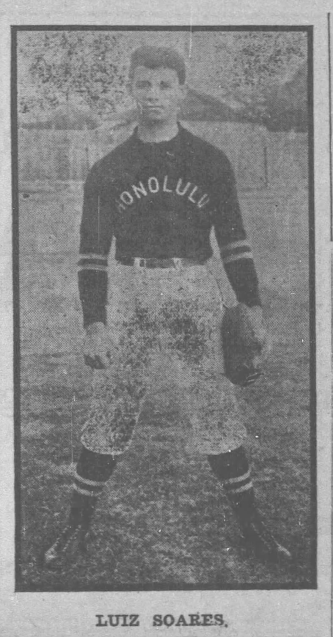
The second game of June 13th was called off by rain - and it was a lucky thing for the Saints, for they were missing En Sue, Jimmy Williams, and catcher Louis Soares. 

The crowd was "better than usual" - an ominous phrase - on June 20th. What there were of the fans watched Diamond Head beat St. Louis 8-6 in the first game. Though Leslie beat the Saints, he "allowed himself to be rattled by the rooters" and walked seven batters. Eddie Fernandez played a spectacular game for the Jewels, going 2-for-3 with two stolen bases, three runs scored, and flawless play at first.

After having thrown three straight good games, Dick Reuter was practically annihilated in the second game: though he struck out ten batters, Punahou made ten runs and fourteen hits off him. Bill Hampton pitched a fine game, allowing the Kams only one run and four hits, and pulled off some spectacular base running in the ninth inning. 

Hampton hit a harmless ground ball and after running halfway down the first base line turned back, as if in despair. The fielder, thinking his job was done, threw the ball back to the pitcher instead of the first baseman. This accomplished, the heady Hampton turned right around and made first base. The umpire called him safe, and while the Kams argued with the umpire he took second and third base. 

The first half of the season closed on June 27 before an "average crowd." Kamehameha beat St. Louis 3-0 in the first game. After Reuter had been hit so terribly the previous week he was replaced in the box by A. Lota, who scattered seven hits and three walks over nine scoreless innings. The Advertiser suggested that Reuter was benched only to give him a rest now that the Kams had no hope for the first half, not because he was demoted in any way, but I wonder. 

Oliver Jones, Kamehameha's catcher, hit a solo home run "over the left field fence for the longest hit of the season" in the fifth inning. With that he had collected a home run in all three of the Honolulu League seasons I have compiled statistics for, 1906-08, the only player to do so. 

Part of the reason for the Saints falling prostrate before the typically mediocre Lota was that they lacked their customary line-up. "Jimmy Williams, En Sue and Aylett were missing from the ranks of the Saints yesterday. Plada and Markham were given a chance to shine, but their brilliancy isn't known to have affected anyone's eyesight." But the Saints' usual line-up didn't gleam much either; their record for the first half was 2-6. The Advertiser eulogized: "How are the mighty fallen. Poor old Saints!"

As always, the Diamond Heads got off to a great start in the second game, scoring three runs in the first inning against the Punahous. But Bill Hampton blanked them the rest of the way and Leslie, despite striking out 13 Puns, allowed two runs in the fifth and blew the game by allowing another two in the 9th. 

Bill Hampton helped his own cause with his chutzpah: "In the first of the fifth Hampton bluffed his way to first on three balls. There is little of that kind of work done here compared with what happens at a Coast game."

There wasn't very much spirit in the stands apart from the ever-loud Jack Doyle: "Doyle's voice gave out and thereafter a gloom pervaded the bleachers which could be cut with a knife." 

On that cheerful note the first half ended.

The first half's final standings ran as follows:

Diamond Head, 6-3
Punahou, 5-3
Kamehameha, 4-5
St. Louis, 2-6

The second half of the season would not start until September. In the meantime two college teams from west and east, Keio University of Japan and Santa Clara University of California, converged upon Hawaii, and played a series of games with the teams of the Honolulu League dubbed the Triangular Series. The series was a lot more lively than the regular Honolulu League, and I'm planning to write a post on it soon. 

The second half opened on September 5 before a "miserably slim crowd." After two months of games between the visiting teams and miscellaneous combinations of the locals, Honolulu's fans were surfeited with baseball and had no passion left for the League. 

The first game of the doubleheader was not very competitive as Punahou beat Diamond Head 8-1. Many regular players were missing from both line-ups. Alfred Castle, Punahou coach and former Harvard star, pitched for Punahou and struck out seven batters, allowing only five hits and walking none. 

The second game was a great one: Lota of Kamehameha and Barney Joy of the St. Louis Saints matched each other 0-0 until the twelfth inning when the Kams finally scored. Joy, who had only begun pitching again in the Triangular series, gave up just three hits and struck out ten in defeat. The Kams turned three double plays after having turned just one all first half. Lota had picked up where he had left off at the end of the first half - throwing shutouts - and his scoreless streak was now at 21 innings.

His streak would pause there. The Honolulu League would play no more games in 1908; fan interest was dead. The Honolulu League would not begin play in 1909 until August, and then only played a six-game schedule. In 1910 it was superseded by the Oahu League. 

The final standings of 1908:

                          W L RS RA
Punahou             6  3   43  29
Diamond Head   6  4   47  40
Kamehameha     5  5   32  51
St. Louis             2  7   27  29

I'm not sure which team deserved the championship, Diamond Head for winning the first half or Punahou for having the best all-around record. Formerly invincible, St. Louis was the only team to finish below .500. They scored the fewest runs in the league by five, and fourteen of their runs came in a single game.

Even stranger than St. Louis scoring half its season's runs in one game was Diamond Head's dominance in the first inning. They scored fifteen of their forty-seven runs in the first inning. The only game in which they failed to score in the first was that of June 6th.

Statistical notes: 

The 1908 Honolulu League was incredibly pitcher-friendly: the league batting average was a scanty .188, and the league slugging percentage was .247. 

Barney Joy led the league in batting average with a mark of .387, and tied Bill Hampton for the lead in slugging percentage with .452. Bill Hampton just hit .258, but three of his eight hits were triples. 

Eddie Fernandez, Diamond Head first baseman, was the best all-around player, leading the league with 14 hits, 13 runs scored, 16 total bases, and 10 stolen bases. 

Akoni Louis, whom the Jewels had snatched from the Saints, hit .344. 

Nani Lemon hit .257 and led the league with four doubles. The Advertiser said of him on June 7th that "Lemon is the same finished player that he ever was. He seems to improve with age, if anything."

Sam Davis, Diamond Head catcher, hit a homer, a triple, a double, and no singles in thirty at-bats. 

The top ten in batting:
.387, Barney Joy, utility, St. Louis, 12 for 31
.379, Harry Bruns, left field, Punahou, 11 for 29
.378, Eddie Fernandez, 1b, Diamond Head, 14 for 37
.344, Akoni Louis, outfield, Diamond Head, 11 for 32
.281, Olmos, right field, Diamond Head, 9 for 32
,259, George Bruns, utility, St. Louis, 7 for 27
.258, Bill Hampton, p-if, Punahou, 8 for 31
.257, Nani Lemon, center field, Kamehameha, 9 for 35
.250, Evers, shortstop, Diamond Head, 8 for 32
.250, Charles En Sue, left field, St. Louis, 7 for 28

Dick Reuter led the league in losses (5), strikeouts (59), innings (70), games started and games (8), hits (60), runs (51), and complete games (8). In other words, the same categories he led the league in in 1907. His 6.56 RA was the worst by 2.47 of anyone who pitched in more than one game.

His replacement, Lota, set a new league record with his RA of 0.00. 

Bill Hampton of Punahou led the league in wins with 5:  he had a 5-2 record, 2.71 RA, and gave up just 34 hits while striking out 44 batters in 63 innings.

Bob Leslie led the league in walks with 26 but allowed just 16 hits - he only pitched in 33 innings. 

Barney Joy only pitched in one game but because it was an extra-inning game and his team only played nine games, he actually qualified for rate statistics. He led in WHIP, with 0.42. 

The fielding was about the same as 1908; the league average went up a tick, from .918 to .919. The Saints had the highest fielding percentage (.936), just like 1907, but they turned the fewest double plays (2) - they had turned thirteen in 1907. Punahou had the second highest fielding percentage (.925), Kamehameha followed them with .912, and Diamond Head, despite its excellence in batting and pitching, brought up the rear in fielding with a mark of .906. 

Here's a link to the stats I compiled if you're interested: https://1drv.ms/x/c/007874164ce0374a/EXOK7cacst5Eg-m0rEmFTi0BKC6oGyRV__l9JnzNUnnZJg?e=o4fKPW


Friday, May 17, 2024

The Gospel of Orlando K. Fitzsimmons

 This is the tale of Orlando K. Fitzsimmons, pitcher, proto-Ponzi, and prolific utterer of fragrant idiocy. Possessing a healthy ego and limitless chutzpah, his life traced a story that is absurd above all else. 


Orlando Kellogg Fitzsimmons was born January 5, 1866 in Reading, Michigan, the last of Jane and Andrew Fitzsimmons' three children. He was named after Orlando H. Kellogg, who ran a general store together with his father.

His parents divorced sometime between 1866 and 1869. Orlando acquired a stepmother when his father married Elizabeth Dixon in 1869. 

His baseball career began as a shortstop in 1883 with the Park nine of Pleasant Lake, Indiana. He continued playing with the club in 1884 but signed in August with a team from Lexington, Kentucky. 

Angola Steuben Republican, 1884-8-13, p.5

He played with the Parks of Pleasant Lake again in 1885, and near the end of the season pitched in some practice games for the National League's Detroit Wolverines. He signed with Detroit in 1886 but didn't pan out. Detroit spent their pre-season in Georgia, and Fitzsimmons pitched twice against Southern Association teams. On March 19 he beat Macon 21-0 before a crowd of 1500, but his next start on March 23 did not go quite so smoothly as Savannah defeated him 13-5. Detroit released him, and by March 28 he had signed with the Augusta Browns of the Southern Association. Pitching for Augusta, he beat Pittsburg of the American Association 2-1 in a pre-season game, March 30.

He pitched fairly well with Augusta in the regular season, winning three games and losing four with an ERA of 2.00 and fifty strikeouts in seven games. His 7.1 strikeouts/nine innings were the fourth highest in the league but he wasn't given the chance to qualify; Augusta released him in late May. He quickly signed with the St. Paul Freezers of the Northwestern League. 

The St. Paul Pioneer Press was excited at his advent, saying: "He is unquestionably an A - No. 1 pitcher. He has great curves, and a most wonderful drop ball. His command of the ball is also good, while he is daily recovering the speed he lost early in the season, when pitching for Detroit." 

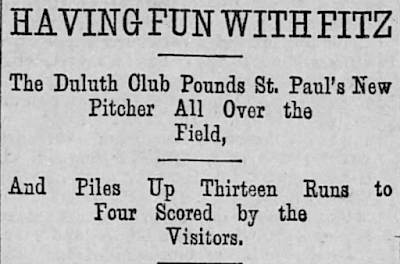
One of his games for St. Paul would continue to be recounted in newspapers for another thirty years. On June 18, pitching against Duluth pitcher Mark Baldwin, who would go on to earn 154 MLB wins and the nickname "Fido," Fitzsimmons struck out twelve batters and Baldwin struck out eighteen for a remarkable 30 combined strikeouts. It wasn't exactly a pitcher's duel, though: Duluth collected sixteen hits off Fitzsimmons, beating him 13-4. (Note that in the box score only one run of the seventeen scored in the game is considered to be earned.)
Saint Paul Globe, 1886-6-19, p.1

Hugh Daily

Fitzsimmons overstayed his welcome in St. Paul and was released on September 13. (In his stead they signed Hugh "One Arm" Daily, a surly thirty-eight-year-old Irishman who struck out 483 batters in the Union Association in 1884.) As a parting gift, manager John Barnes fined Fitzsimmons $50 for losing 7-6 to Milwaukee on the frigid Sunday of September 12. The Duluth Jayhawks signed him on the rebound and he stayed with them until the end of their pennant-winning season.

Saint Paul Globe, 1886-10-10, p.5

Fitzsimmons pitched for five different teams in 1887. He spent most of the year in the Western League, going 9-5 for the Leavenworth Soldiers, 5-4 for the St. Joseph Reds, and 5-1 for Denver. He finished the year back in the Northwestern League and pitched miserably: On September 14 he pitched for the Milwaukee Cream Citys but had no control and was hit hard; he left the game after four innings. On September 17 he pitched for Duluth but was so wild he had to be taken out after seven innings. An ignominious end to his season. 

In 1888 he was briefly with Jackson of the Tri-State League but was back in his hometown, Reading, by July, pitching for the town team. He lost 16-4 to the Angola Grays on July 13 in the one game I can find a score for. 

By the end of the season he had come full circle in his baseball career: again he was an infielder,  a second baseman this time; again he played for Pleasant Lake, Indiana. 

As far as I am aware he never played baseball again. Business henceforth would be his realm. He began it inauspiciously: in the winter of 1889-90 it was noted that he was "on the road selling fruit trees." 

From 1890 to 1892 the newspapers declared not his name but it was not an uneventful time for him: in 1892 he married Mary Green of Dexter, Michigan, a lady close to eight years his junior. 

He popped up again in Owosso, Michigan, in 1893. He was hired as an agent of the American Express Company. As of June 30 1893 he had handled about 400 crates of strawberries, whatever the significance of that is. 

On June 8th 1894 it was reported that he was a member of the fledgling Silver Dandruff Cure Company which the Owosso Times heartily endorsed. 


Warranted to cure all skin diseases? I bet.

Whatever its merits or lack of them, the Silver Dandruff Cure Co. does not seem to have survived past 1895. 

Fitzsimmons' newspaper trail runs cold for a half decade after that until December 6, 1900, when the Victoria Daily Times reported that he had arrived in Victoria, British Columbia on the steamer Charmer from Vancouver.

I have no idea why he was in Victoria.

He volunteered to coach Victoria's baseball team in 1901, and the team was very happy to have an old pro like him at the helm. The Victoria Daily Times described him at various times during the season as "energetic and capable," and "experienced and level-headed."

The team had one future pro: Thomas Holness, who would win two games and lose nine for the Victoria/Spokane team of the Northwestern League in 1905. 

No further trace of Orlando can be found until November 1902, when advertisements of his began to appear in the Los Angeles Evening Post-Record. 

This is where the bizarre part of his story begins. Brace yourselves, folks, for a lot of nonsense. 

The advertisements promised that the reader could earn 8% to 10% profit a month by depositing a mere $1.00 per week with Orlando K. Fitzsimmons. 

His headlines blared the plan's virtues: "RAPID MONEY," "INDEPENDENT MONEY," "MONEY COMES EASY," etc.

"Don't be timid," Orlando said. "Fear destroys opportunities and undermines success." But there was no need to fear, anyways: the plan was "absolutely safe and sure." 

"Don't be afraid," Orlando said, "for there is no hidden monster; only first truth." "I would not mislead you for the state of California. I have no incentive for misleading you." 

"Be like Napoleon" and do "not tremble before that old bugaboo, 'IMPOSSIBLE.'" 

'kay. 

The Los Angeles Herald got in on the act with an interview of him published on December 21, blithely presenting his twaddle as news and calling his Tontine Investment Company of California "up-to-date and apparently reliable." 

From the interview:
Q: "What is the nature of your business?"
A: "It is hard to explain clearly in a very few words, but, were I to attempt it, I would say that we keep money constantly moving in such a way that one dollar will cancel many dollars' worth of obligations in a short space of time."

Constantly moving money around apparently delivered 100% profit, for Fitzsimmons went on to explain that patrons receive $160 for every $80 they put in. He explained that all this was merely the law of evolution at work, the law of evolution comprising two forces, growth and change, which when working in harmonious unison apparently bred money like rabbits. 

It didn't take too long for him to get called out. The Los Angeles Times published an article on February 17, 1903, summing up his pamphlet "How to Make Money Quickly, Honestly, and Legitimately" as a get-rich-quick scam for suckers. Fitzsimmons was now promising to bestow 15% to 25% profit upon his patrons each and every month. 

All by moving money around. The Times quoted the pamphlet's explanation: 

"Now, we return the 'profit' to our patrons under a perfect coöperative system, whereby, under certain fixed laws, we move or circulate among our members the money received in such a way that $1 produces many dollars' worth of 'profit' in a very short time." 

"Clear as mud," the Times replied, "and equally attractive to the normal intellect." 

Fitzsimmons quickly fired back with advertisements in the Post-Record challenging those "ignoramuses who like to pose before the general public as thinkers" to a debate, but nothing ever came of it. 

All was relatively quiet on the Fitzsimmons front until June 14, when the Los Angeles Times exposed the "BRAZEN BLASPHEMY OF 'RICH-QUICKSTER.'"    

The Times was referring to the May issue of Fitzsimmons' new mouthpiece, the Federation Herald, published by the Rev. E.H. Brooks, later described by the Times as "clerical floater and persistent beggar." A picture of Christ graced the cover; within were pages upon pages extolling the greatness of Fitzsimmons' Cumulative Credit Company. It was "a door of hope to the struggling millions," delivering the downtrodden and disheartened out of destitution and into prosperity not by cutthroat capitalist competition, not by the adoration of those "two mighty kings... Selfishness and Greed," but by the Golden Rule. 

The company's logo

Practical details sullied not the publication's pages: "Space here will not allow an explanation of the details, but the main point is that we dethrone money as master and make it man's servant. It is faithful, willing and obedient when properly used, for is it not a creature of man's creation? Our mission to the material plane is what Christ's was to the spiritual." 

The Times noted that "Believers in omnipotence may well wonder why lightning does not strike the propagators of the Federation Herald."

The Los Angeles Post-Record, no doubt uninfluenced by the fact that Fitzsimmons was a steady advertiser in its pages, devoted its entire sixth page on June 20 to parodying the Times and uncritically quoting Fitzsimmons. 

E.g.: "THE TIMES HAS NOT INVESTIGATED THIS CURSED INSTITUTION FURTHER THAN TO READ ITS LITERATURE IN A DESULTORY MANNER, BUT EVERY UNTHINKING, PARROT-LIKE MAN SHOULD KNOW THAT IT IS IMPOSSIBLE TO DO WHAT THIS CONCERN IS DOING AND WHAT HAS BEEN DONE FOR MANY YEARS.    
    "WHEN A NEW IDEA LOOKS AS THOUGH IT MIGHT BE SUCCESSFUL, IT IS TIME TO SQUELCH IT, FOR MOST PEOPLE DO NOT WANT ANYTHING NEW."

Etc. 

The Post-Record's response to the Times was infantile. The Times' article was based upon prior articles establishing that Fitzsimmons' company was a scam. The Times called Fitzsimmons blasphemous not merely because he was promising to apply the golden rule to business and comparing his work to Christ's, but because the business he was pretending was Christ-like was a fraud. By taking the Times' article out of context and then drowning it in reams of Fitzsimmons' eloquent emptiness, it exercised no impartiality. It was simply an attack on the Times and a defense of their advertiser. 

The Times published a reply on June 24 further skewering Saint Orlando Fitzsimmons' (their phrase) pretensions to unworldly righteousness which flavored his "$2 for $1" siren-call. The article makes plenty of good points, though its headline "CLAIMS TO BE THE MESSIAH" is pretty misleading - what Fitzsimmons said was that his material mission was akin to Christ's spiritual mission. Isn't that ridiculous enough without having to distort it? 


The Post-Record did not take this lying down, and devoted a second full page to Fitzsimmons' defense. Its centerpiece is this lovely depiction of the Times as a great ugly mud-slinging lover of big business futilely endeavoring to destroying such unworldly institutions as the Cumulative Credit Company and the Point Loma Universal Brotherhood and Theosophical Society.


The main thrust of the Post-Record's arguing was that Fitzsimmons' enterprise was like the New York Life Insurance Company, only better. Or rather, the Post-Record printed Fitzsimmons' bizarre and long-winded arguments to that effect. 

The newspapers' cat-fight petered out after that, thank God, not before I lost a lot of brain cells. 

By September 9 the Federation Herald was defunct. It went out with a bang, according to the Times, composing in its last issue a new "Credo" that began "I believe in Orlando K. Fitzsimmons." 

The early months of 1904 brought the Cumulative Credit Company nothing but woe. In January the company became the subject of an investigation by a grand jury. Some interesting facts were brought out. Since the company's start it had issued 46,000 weekly certificates - not taking into account certificates that had matured or lapsed, that represented $46,000 a week, a quarter of which was set aside for the company's expenses. Though that figure was an exaggeration, it helped explain the company's opulence, which was described by the Times thusly: 

"That it is a real good business - for the company - has been apparent for some time. The offices on Broadway are extensive, well appointed, and in a measure luxurious, and the cost of keeping the broad span of window space in such a polished condition that the suckers may see themselves as they pass cannot be a trifle."

A disconcerting clause was discovered in the certificates themselves. The certificates promised to pay to their bearers at their maturation $2 for every $1 they had invested provided - here's the catch -  "Provided that there shall be sufficient money in said Mutual Benefit Credit Fund available for that purpose to pay said amount." If there wasn't enough, that would just be too bad. And it was very likely there would not be enough. As Judge Wellborn of the United States Circuit Court would explain in March, about 30% of the $80 from each certificate was set aside for the company's use, leaving just $56 to pay the $160 promised. The shortfall could only be made up by the hooking of two more suckers; and they in turn could only be paid by hooking four more suckers, etc. In other words, Fitzsimmons was Ponzi while Ponzi was still in Italy, though he operated on a smaller scale than Ponzi would. 

Investigation by grand jury did not go well for the company. On February 22 the Assistant United States Attorney General declared the company a fraud, and barred it from using the mail. No letters addressed to it nor to its president (Fitzsimmons) or secretary (M.E. Johnson) would be delivered. It could neither give nor receive money with postal money orders.

Predictably, the great Orlando declared himself and his associates to be martyrs, and complained that the rights of the company's patrons were being trampled under foot. 

But he was not deterred; no amount of oppression at the hands of a government in the pocket of Big Insurance could quell his salvific fire. In a circular mailed out to his followers, presumably before March 1 when the order to stop his mail became official, he included a poem of his own composition entitled "Too Fast" which went like this:

The poem reminds me of the songs Toad sings in The Wind in the Willows. Its shameless egotism is reminiscent of "The Song of Toad" while its ending refrain echoes "When the Toad Came Home." 

But Fitzsimmons did not confine his defiance to doggerel. 

The Cumulative Credit Company expanded into Iowa, opening an office in Cedar Rapids; the Cedar Rapids Gazette published an article on June 16th, 1904, deriding it as a get-rich-quick scheme, and panning the book Fitzsimmons had recently published. After quoting the book extensively they concluded: "it is inane stuff, to say the least." That book, a slim thirty-eight page volume entitled Financial Ideas Worth $5000 to You - If You Can Comprehend Them! can actually still be read on archive.org, not that I recommend it - it's just an extensive advertisement. Any morbid curiosity you might have about it can be sated at: https://archive.org/details/financialideaswo00fitzrich/mode/2up

The company also opened up offices in San Francisco later in the year that occupied "half a dozen rooms in one of the best office buildings in San Francisco. The rooms are fitted up like a bank. [Fitzsimmons] has a large staff of stenographers and clerks.... His business shows every sign of prosperity notwithstanding the painstaking efforts of Uncle Sam to drive him out. He has the most astonishing flow of language. He has got hold of the jargon of insurance and actuarial science and will reel it off to you by the hour. It is an awful death if you can't escape in time." (Stockton Evening Mail, 1904-12-10, p.4)

But the beginning of the end was nigh. He was arrested January 7, 1905, in San Francisco. He gave his name as Adolph, and was let free on a bond of either $2,000 or $5,000.

His arrest was due to his refusal to stay away from the mail; he had worked around his postal proscription by having his mail sent to him under miscellaneous Chinese names at his office in the Callaghan building of San Francisco. 

Inappositely, at almost the same time he was arrested a new book of his entitled Financial Ideas was published. On one of the leading pages these words were emblazoned in large type: "We need not worry about the sun's cooling off, nor the depopulation of the earth, neither need we fear the time when the Cumulative Credit system will commence to retrograde, for that is only when its blessings have covered the entire earth, and there are no more people to reach."

On page nineteen he drew a verbal "likeness" of himself:

 "Here is the staunch business man. Through the broad shoulders and fully-developed chest can be seen great physical endurance, while the keen, bright eyes, the clear-cut features and strong, heavy jaw indicate executive ability and the indomitable will power that has characterized his life.

 "But these qualities, valuable as they are to the head of a great enterprise, are not sufficient to carry to successful issue the stupendous plans conceived by him. To these must be added those of the philosopher and teacher - the man who can conceive a great idea, and present it intelligently to the masses."

You can't make this stuff up. 

Meanwhile, in reality, in May he was granted a divorce from his wife, Mary, for her desertion of him. By the terms of the divorce she received $3,000, $100 a month, and their daughter Virginia. 

At the same time, M.E. Johnson, Fitzsimmons' former partner, filed a suit against him for nonpayment; in 1904 Fitzsimmons had bought Johnson's stock in the company but had yet to pay either $6,500, according to Fitzsimmons' statement, or $17,500, the LA Times' statement. Whatever the figure was, Fitzsimmons said he didn't have enough money to repay Johnson.

I don't know how that suit turned out, but Fitzsimmons spent a few months in Chicago and published a new booklet called "What Has Been Done and Why." He returned to California on September 16 for his trial. The court had a difficult time picking out a jury, but Fitzsimmons was eventually convicted on eight counts of using the United States mails for a lottery. 

On reporting his conviction the Post-Record referred to him with chill sarcasm as "the man who conceived the brilliant scheme of bettering the condition of the poor by giving them $100 for $50." Apparently they had forgotten their rabid support of him a mere two and a half years prior; but perhaps it was not so obvious then that shuffling around money and talking up a storm does not make 50 equal 100. 

On October 9th Fitzsimmons was sentenced to six months in jail, accompanied by a $250 fine. His two business associates, John W. Neighbors and E.A. Arnett, were also convicted and were fined $250 each without jail time. 

They got disgustingly light sentences, really -  for context, F.B. Parker, the local manager of the Cumulative Credit Company in Washington, was sentenced to a year in jail and a $1000 fine in August, and even that was far from the maximum sentence  - but the trio appealed their sentences. Fitzsimmons was let free on a four-thousand-dollar bond. 

In early 1906 he published yet another book, this one called Metamorphose: Involving Regeneration of Individual and Race, and Also the Solution of the Great Problem of Poverty. 

The Fresno Morning Republican called it "an interesting sort of fraud. On its face, it appears to be a fantastic jumble of Socialism, mysticism and greenbackism, written in the turgid and meaningless style affected by devotees of freak cults.... There is also much blasphemous appeal to the sanctions of religion and impious misquoting of the words of Christ." 

In mid-1906 Fitzsimmons founded a new organization  called the World Betterment League with offices in Chicago and Buffalo. He hooked about 200 followers in Buffalo on the promise that $5 a month or more would get them from 50% to 120% profit, and left town before his flock got back a dime. 

He married the 27-year-old Amy L. Brown in 1906. 

His appeal was denied by the United States circuit court of appeals, October 7th, 1907, Judge Gilbert ruling that he had indeed used the mails for his lottery schemes. It's odd that apparently the only law that could be used against Fitzsimmons was a law against conducting lotteries by mail. Judge Gilbert said the Cumulative Credit Company was a lottery because there was a discrepancy between the money put in and the expected prize, explaining that:

"The subscriber to the scheme knows full well that no increment is to be earned by his money, but that all returns are to come from his own contributions and the contributions of others. The chance of getting back from these sources double the sum that he pays in, and getting it soon, is the prize which lures him to make the payments."

But that was a completely false description of what Fitzsimmons' patrons believed. Fitzsimmons did not advertise his certificates as lottery tickets but as guarantees to pay their owners $2 for every $1 they put in. The Cumulative Credit Company preyed upon "those of little means and less business acumen," according to the front page of the Los Angeles Evening Express of 1907-11-18. His patrons did not "know full well that no increment is to be earned by his money" - they were clueless and desperate, in need of the financial salvation Fitzsimmons promised them. Some continued to give money to Fitzsimmons even after the Cumulative Credit Company was put out of business in Los Angeles, apparently not being close readers of the newspapers. They were suckers, not gamblers prepared to lose.

On August 24th, 1905, the Los Angeles Times told the story of G.W. Packer, a sober, dedicated, middle-aged carpenter who was driven insane after he lost all his life savings investing in Cumulative Credit. He had hoped for some financial independence in his old age.

Fitzsimmons was a liar and a thief, a proto-Ponzi, not a lottery conductor. 

Laws are strange things. 

When Fitzsimmons heard his appeal had been denied he gave himself up to a United States marshal, paid his $250 fine, and headed to jail for a six-months' stay. He was released from jail on May 20, 1908. 

There is little of news of the great Orlando past 1908. He had a son, Fielder Dwight Fitzsimmons, born unto him in 1912 in Portland. 

In 1914 he was indicted, along with five other men, as the secretary of the National Mercantile company of Vancouver. The charge? Using the mails to promote a lottery. He was described as a resident of Vancouver at the time. 

The last mention of him in a newspaper alive is a article from May 1, 1931, in the Los Angeles Southwest Wave, describing a speech he gave to the Los Angeles Realty board in which he detailed how all the money moldering away in American savings accounts was bogging down the economy. Sounds Keynesian, actually. The newspaper described him as an "author and economic specialist."

In 1940 he copyrighted the phrase "Direct way to business betterment";  it seems like he was keeping busy in his old age. 

He died August 23rd, 1950, in Pala, California. He was 84, an inappropriately ripe old age for such a sinner. Who can ken the world's workings? 


Saturday, March 30, 2024

The Month Newt Parker Hit Like No Other

 Newt Parker, listed as William Parker on BR, was a big, big-hitting first baseman in the low minors of the South from 1939 to 1953. Most of his seasons were good but not great - nothing you'd remember eighty years later. But his 1941 season looks like a misprint.

Known as Newton "Gashouse" Parker in college, Newt played baseball and basketball for the Middle Georgia College (MGC) Wolverines from 1937 to 1939. He played third base on the diamond and center on the hardwood, and won the junior college basketball title of Georgia with MGC in 1939. 

Newt is second from the left, back row. Macon Telegraph, 1939-2-23, p.8

He spent the summer of 1939 playing for the Callaway Cubs of the Middle Georgia Textile League. The only game report I found that mentioned him was the game of June 24, in which he hit a 410-foot homer, a double, and a single, leading Callaway to a 28-2 win over Dixie.

Atlanta Constitution, 1939-6-25, p.18

The star pitcher of the Calloway Cubs was Royce Mills, who would win 89 games and lose 67 in the low minors from 1940 to 1952.

Newt Parker made his entrance into pro baseball late in 1939, playing 14 games for the Kannapolis Towelers of the class D North Carolina State League. His batting average was only .255 but he made his hits count, slugging three homers and three doubles in his 47 at-bats. 

Newt spent 1940 with the Jackson Generals of the class D Kentucky-Illinois-Tennessee League. Its friends called it Kitty. 

He batted .291 and tied his teammate, outfielder Joe Polcha, for second place in home runs with 27 in 118 games. (1940 was Joe Polcha's only year in pro ball.) He finished 2nd in RBIs with 108, 47 shy of the 155 driven in by former major leaguer Mike Powers. He also struck out 128 times, 26 times more than anyone else in the league. 

He was considered to be the league's top fielding first sacker. His large size - 225 pounds - would have been a liability at any other position, but provided some much-needed margin for error for the throws of his infielders. "Parker was made of rubber, could stretch a mile, and furnished an excellent target for the infielders." - Jackson Sun, 1941-6-01, p. 11.

It was an impressive season, and during the winter meetings the Tulsa Oilers of the Texas League bought his contract. He went to spring training with the Oilers but was optioned back to Jackson at the start of the season, subject to twenty-four hour recall.

The Jackson Generals' season opened May 11. Parker hit a two-run homer, a double, and a single, driving in three of the General's four runs in a 4-2 defeat of the Union City Greyhounds. With that, Newt Parker began one of the most remarkable months of power-hitting in baseball history. 

Over the next eight games, from May 12 to May 20, Parker hit a home run in every other game. He scored at least one run in every game but one, the only exception being May 15, in which the entire General team was shutout by Union City Greyhounds' pitcher Donald Bakkelund. As of May 20, he had a .355 batting average (11 for 31), five home runs, and three doubles, for a slugging percentage of .935. 

He cooled down a little after that. He didn't hit a single homer in a two game series vs. the Mayfield Browns May 21-22. On May 23, he had a homer, a double, and three runs scored against the Hopkinsville Hoppers, but the next day was just 1-for-4 with a single. 

That's when he really got going.

On May 25 he went 4-for-4 with a homer against the Hoppers, and hit at least one home run in each of the following six games. He hit one in each game of a two game series against the Fulton Tigers, May 26-27. Next came a four game series against the Bowling Green Barons. He hit two in the first game, one in the second, and in a doubleheader on May 30, hit two in each game - seven home runs in the four game series. All told, he hit ten home runs in seven games over six days, with a home run in every game.

And then the Tulsa Oilers recalled him and sent him to play with the Hutchinson Pirates of the Western Association.

Jackson Sun, 1941-6-01, p. 11

He wasn't happy to go. The Jackson Sun of 1941-6-01, p. 11, quoted him as saying: "I hate to leave here hitting like I am. I want a shot at the home run record in the Kitty." 

His final stats for Jackson were eye-popping: A .405 batting average, 16 home runs, 37 RBIs, 30 runs scored, 30 hits, 7 doubles, and 14 walks in 20 games. His slugging percentage was 1.149.

The final stats of the Kitty League saw him finish 8th overall in home runs, with 16 - the league leader hit 30 - despite playing in less than a sixth of the season. 

https://1drv.ms/x/s!Ako34EwWdHgA6ABDiVRp0tl22sok?e=K445cI

The RBIs in this game-by-game record are two short - the Jackson Sun wasn't terribly scrupulous about keeping accurate count of RBIs. I counted him as having 75 at-bats while the official Kitty League records list him with 74 at-bats; I'd probably trust the official records there.

The Jackson Sun predicted at his parting:

    "The club owners will feel his presence in the Western Association. He is a very expensive ball player. He knocks boards off the fences, loses baseballs, and according to some players in this man's league, he packs a pretty mean right."

But Newt didn't have enough time with Hutchinson to knock any boards off of fences, let alone show off his 'mean right' in battle. After three games, possessing a sound mind in a sound body and a nullity of dependents, Newt was drafted into the army. (He had only managed to hit two singles in those three games for Hutchinson.)

He didn't return to pro ball until 1946.

For two seasons, he lived the life of the baseball nomad. In 1946, he played for the Leaksville-Draper-Spray Triplets of the Carolina League, the Tarboro Tars of the Coastal Plain League, and the La Grange Troupers of the Georgia-Alabama League. 1947 was split between the Tarboro Tars and Roanoke Rapids Jays of the Coastal Plains League.

He was decent in both years - .278/9/92 in 111 games in 1946, .302/18/84 in 103 games in 1947 -  but nothing like he had been in that charmed month of May 1941.

In 1948 he was hired to manage and play first base for the Edenton Colonials of the semi-pro Albemarle League; he would lead them to three Albemarle League pennants from 1948 to 1950. In 1948 he tied teammate Johnny Bohonko for first in the league in home runs with 14, and was leading the league in homers in 1950 when the league folded. After his nomadic years of 1946 and 1947, he was able to stay in one place long enough to become a local favorite. 

He was a "quiet, easy going man off the field," but as a manager he would get "really worked up during a game" and his arguments could be spectacular. (Raleigh News and Observer, 1951-3-28, p.14)

The Edenton Colonials joined the class D Virginia League in 1951, and Parker moved up with them. They finished third out of six teams, with a 63-55 record. Parker was their best batter, hitting.303/19/73 in 96 games and tying for second in the league in home runs.

Parker managed the Colonials in a third league in 1952, the Coastal Plain League; the Virginia League had collapsed of ennui. He did not retain his post for long. He hit a meager .214 with three homers in 47 games, was released, and signed on with the Palatka Azaleas of the Florida State League, with whom he hit .163 with three homers in 13 games. 

But even after Parker left Edenton, his legacy lived on in John "Monk" Raines, who Parker had signed to his first pro contract in 1951 for the Colonials. 

John Raines was a 5'9" righty pitcher with an impressive pedigree. He was a four-sport star for Presbyterian College in Clinton, South Carolina, and he set the South Carolina college strikeout mark with 20 in a 1948 game. He pitched for the Kingstree Royals of the semi-pro Palmetto League in 1950, winning 17 games, losing 5, and averaging 15 strikeouts a game. (Raleigh News and Observer, 1951-3-28, p.14)

Raines was good for the Colonials in 1951 - 16-13 record, 134 strikeouts, and a 3.61 ERA - but in 1952 he was great. In the regular season, he won 26 games, lost 5, struck out 244 batters, and had an 1.48 ERA. He earned a new nickname, "Iron Man", presumably because he never needed to be relieved - he completed all 29 of his starts. He threw two one-hitters and two two-hitters. (1952-9-04)

In the Coastal Plain play-offs, he won another three games without a loss to finish the year with a 29-5 record. The Edenton Colonials had finished third out of eight in the regular season with a 69-55 record, but swept through the playoffs like a devouring flame, sweeping the Wilson Tobs in four games in the semi-finals, and winning four out of five against the Goldsboro Jets in the finals to win the championship.

1952 proved to be the last season of the Coastal Plain League, which had been playing since 1937, and 1953 proved to be Newt's last season. He managed the Hickory Rebels, in the class D Tar Heel League, to a 46-66 record, and batted .290/2/15 with 22 walks in 107 at-bats in 45 games. 

He was also reunited with John Raines. Raines had been sold to the Atlanta Crackers of the Southern League in December 1952. He made the Crackers team out of spring training as a reliever, but was sent to the Hickory Rebels after pitching in five games. He was good for the Rebels, with a 12-5 record, 112 strikeouts, and 4.10 ERA in 23 games, but it was his final year in baseball; he, too, finished his career with the Hickory Rebels. 

Newt Parker should be remembered for his short flash of glory, those two weeks in May 1941 in which he hit in a way few had done before and few have done since. But he should be remembered for more than that. 

Fred Snodgrass used to complain that all people ever remembered him for was his error in the 1912 World Series. "You'd think I was born the day before and died the day after." The case of Newt Parker is a bit different in that no one remembers him for anything, but the principle in unearthing him is similar. The career of William Newton (Gashouse) Parker lasted fifteen years, not two weeks. Though the things he did outside of May 1941 may not have been so spectacular, they were no less valuable. They were just quieter, and harder to see from the distance of time. 

Sunday, March 10, 2024

A year without Joy: part three

  I wrote a crazy long post about the 1907 Honolulu League season which I feel compelled to break up; this is the third and final part.
Part one 

 In the first game of July 6 Kamehameha beat Punahou 11-5. Bill Hampton was demolished; he gave up 11 hits, walked five, and gave up a homer in the eighth to Bill Vannatta, who hit the ball over the center fielder's head and had scored before the right fielder could throw home. It was his second homer of the year, and the sixth in the league altogether.

Evening Bulletin, 1907-6-01, p.1

Reuter was hard to hit - he gave up just three hits - but also surrendered six walks, contributing to the Puns' five runs.

Attention was also given to Kamaiopili, who made his debut for the Kams in the game, hitting ninth and playing center field. In the second inning, in which the Kams scored eight runs, he laid down what was considered to be "the prettiest bunt of the season," a single that brought in a run. It was to be his only hit in 14 at-bats that year, though throughout it all he was honored as a beautiful bunter.

The Punahous had now lost three straight, after having finished just one game behind St. Louis in the first half. 

In the second game, St. Louis beat the Diamond Heads 9-0 as Clown Leslie was found for ten hits. His opponent, Bushnell, threw his second shutout of the season. St. Louis was now tied with Diamond Head in the standings at 2-1.

From June 15 to June 29, Leslie had given up four hits in twenty-four innings. In the two games since then, he had given up twenty-two hits in seventeen innings. 

Punahou was likewise falling fast, but there was hope. Returning to Hawaii on a steamer from the mainland was Alfred Castle, a Punahou alumni who had pitched for Harvard. He was 6'0", 150 lb., and a fine pitcher in the Ivy League. His greatest athletic moment at Harvard came on June 6, 1906, in a game against Brown University. He threw a no-hitter, walked no one, made the only two hits of the game himself, and scored the only run. (Harvard made four errors, so it wasn't a perfect game.)

Castle graduated from Harvard in 1906, and finally returned to Hawaii just in time for the doubleheader of July 13. Maybe he could set things right for Punahou. 

Cartoon depicting Doc Monsarrat, Punahou manager, greeting Alfred Castle with joy. Advertiser, 1907-7-13, p.5


The first game of July 13 was a tight pitcher's duel between Andy Bushnell and Dick Reuter. St. Louis scored two runs on four hits and the Kamehamehas scored one run on five hits as Bushnell won his third straight game.

Al Castle was set against Leslie and the Diamond Heads (now that's a good band name) in the second game. The Jewels scored five runs off Castle in the first inning, and that was the game. Castle was highly mediocre, and the Punahou defense was no better. The Diamond Heads scored ten runs on eight hits, four walks, and six errors. The Advertiser was sympathetic to Castle, saying that "it was not fair to be expected that so soon after a sea voyage Castle would be up to his own standard, though after the first inning he held things down."


Alfred Castle. Advertiser, 1907-7-20, p.5

The first game of the July 20 doubleheader "was so poor that the crowd was hardly satisfied." The Diamond Heads beat the Kams 7-4 on just four hits; the Kams made seven errors and the Diamond Heads made six. 

Nani Lemon hit a homer, a "beauty," off Leslie in an abortive ninth inning Kam rally. He was also called out by the Advertiser for "the way in which he loafs before going to bat. Several times yesterday he delayed the game by his inattention."

Advertiser, 1907-7-20, p.5

The first game may have been a poor one, but the second game "made up for everything that was lacking in the first contest." St. Louis fought the Punahous twelve innings before finally coming out on top, 6-5. 

Eddie Desha had quite the game. He hit a double in the fifth and a homer in the seventh. He started the game for Punahou, the first game he'd pitched all year, and went six innings before he switched places with third baseman Bill Hampton with the score tied at 5-5. All five runs St. Louis scored had been unearned. 

Bushnell and Bill Hampton traded zeroes until the twelfth when Bushnell won his own game. He got on first by a fielder's choice, stole second and third, and scored on a passed ball. 

The Advertiser commented the next week that "Bushnell and Soares make an ideal battery. They are working together in fine shape and for two youngsters have a fine baseball future ahead of them."

Neither Bushnell nor Soares had been much of a factor in the first half - Bushnell played more outfielder than pitcher, and Soares was on the Coast until June 22 - but they became absolutely essential to St. Louis in the second half. 

Soares was not much of a hitter - though he had led the league in home runs with two in 1906, he hit only .141, and would hit only .111 in 1907 - but he was an excellent fielder, by the far best defensive catcher in the league, going by statistics. In 1907 he made but one error and allowed but one passed ball in ten games, and made 21 assists. 

Advertiser, 1907-9-08, p.13

 The Advertiser was in awe of Evers - all rancor over his money demands was gone. "Evers, the shortstop of the St. Louis team made a catch in the seventh inning off Hampton's bat, that was a wonder. Running backwards at full speed he jumped into the air and caught a ball that there are few major league men could have handled." [somebody needed an editor] The next week the Advertiser called Evers the league's "bright particular star at short."

For the third straight week, the Diamond Heads and St. Louis were tied for first place - now at 4-1. Kamehameha was third at 2-3, and Punahou was languishing in last at 0-5. 

There was no baseball on Saturday, July 27. Percy Lishman had died. He was a long-time player, and very popular. He had been traveling on the steamship the Siberia from Honolulu to San Francisco in April. Soon after the ship had left Honolulu he fell on the deck of ship, and afterwards seemed a bit "crazed." Just a day into the voyage he cut his throat in a suicide attempt, but survived "due to the prompt action of surgeons on board the ship." "After his wound had been treated he repeatedly threatened to kill himself, and said he would never be landed alive in San Francisco." He was kept under close watch for the rest of the voyage.  "When the steamer arrived [in San Francisco, April 28], Lishman was considered out of danger and his chance for recovery good. No reason was found for the suicidal act, except that he must have become temporarily insane." (The San Francisco Call and Post, 1907-4-29, p.1) 

Advertiser, 1907-7-18, p.2

It was believed he had made a full recovery. He traveled on to New York, and met a number of his Honolulu friends there. He seemed to be in good spirits, and in July decided he would return to Hawaii together with them. "Lishman had already bought his railroad ticket via the Canadian Pacific, however, and the others were returning by a different route, so he came alone across the continent." He killed himself in Vancouver. He was just 31. 

And do you know what caused him to fall on the deck of the Siberia in the first place, starting the whole tragic series of events? It was a rope stretched "between the Caucasian steerage and that assigned to men of other races." He was running in the dark and tripped on it; it was supposed to be kept waist-high, but had sagged during the night. The story is like a symbol of the tragedy and insanity of segregation. It's just a shame that Lishman had to act it out. (Los Angeles Times, 1907-5-05)

Life goes on after tragedy, if fitfully, and the next Saturday there was baseball again.

There was a large enthusiastic crowd on August 3. "The bleachers, and in fact the whole grandstand, was overflowing with advice to the players and opinions of the game." 

Kamehameha defied the odds, beating St. Louis 6-4 in the first game. It was Bushnell's first loss since Paul Burns quit the team. Kamehameha third baseman Lota hit a homer off Bushnell in the sixth inning. It was the ninth and last home run of the season. 

Kamaiopili started in left field for Kamehameha and the crowd cheered for him loudly, remembering his brilliant bunt of July 6. It was his first game since then. The Advertiser summed him up so: "He is a youngster whose chief recommendation is that he is a willing performer." A charitable description.

Evers starred in the field again, making "a beautiful running catch bringing down a high fly with his left hand."

The second game was tied 5-5 until the tenth inning, when the Punahous scored three runs. Bill Hampton was the star of the game. Eddie Desha started, but switched places with Bill Hampton at third for the second straight game, this time after just three innings. Punahou was down 5-1 at the time. 

But Punahou started chipping away, scoring three runs in the sixth, one in the eighth, and the three in the tenth, Hampton pitched six scoreless one-hit innings, and the Puns had finally won their first game of the second series. David Desha starred at the plate, hitting a pair of doubles.  

The Diamond Heads and St. Louis had both lost, so they were still tied for first, but Kamehameha was now just a game behind them. The pennant race was wide-open. 

August 10 turned out to be the day of Bill Hampton... for all the wrong reasons.

The Advertiser led off the sports section thusly:

"The Punahous lost, but Hampton lost his temper. A disastrous defeat in which however there was no discredit, was made discreditable by an outbreak on the part of Hampton, which absolutely appalled the spectators, so that for an instant there was absolute silence, and then a storm of hisses and exclamations of disapproval, as the crowd realized what had been done, and burst out in indignant resentment at the display of such spirit." 

The incident that called down wrath from above occurred in the sixth inning. Punahou was losing 5-0 to St. Louis. Bill Hampton came to the plate with two outs in the first half of the sixth and "a good deal of talking" coming from the crowd. He struck out. As he was trudging back to the dugout, his bat still clenched in his hands, he stopped in front of the grandstand and angrily asked "who was making the remarks he resented." No answer. 

Hampton returned to the dugout and came out to the pitcher's mound to face St. Louis. "Instantly there was a renewal of talk across the field, the expression 'kill it' being used several times. Gleason was at bat, in position, waiting for the ball to be pitched, when suddenly Hampton threw the ball with violent energy in the direction of the crowd at the rail in the carriage paddock right at the makai* end of the grandstand. The ball passed over the heads of the crowd but not very much over their heads, if indeed active dodging was not the only thing that saved somebody from being hit."

*Makai means "sea-ward." 

The crowd did not react well to this, as you might imagine. The St. Louis team was not particularly pleased, either, and "it looked for a time as though there would be trouble between the rival teams. There was a good deal of discussion, and some heat developed." 

When the Chief of Detectives asked Hampton whether he threw the ball intentionally, he replied: "What if I did? I have a right to throw the ball anywhere I please in the field." Okay... 

Hampton probably wished he was back in Maui, where at least the crowds were quiet. 

The Advertiser reported that "It was generally understood that Hampton's anger and the ball he threw were directed at Jimmie Thompson, who was coaching from his position just behind the benches."

Jimmy Thompson's rooting had drawn attention before; the Advertiser wrote on June 9 that: "The coaching of Jimmy Thompson, from the Clerk of the Supreme Court's office, was refreshing. He should keep it up." He did, and look what happened.

Advertiser, 1907-8-17, p.6

But a fight was averted, everyone settled down enough to continue, and St. Louis beat Punahou 8-0.

Everything else in the game was overshadowed by the maelstrom of indignation, but Bushnell pitched a beautiful game. He struck out nine and held the Puns to three hits in his third shutout of the year.

In the other game, Kamehameha beat Diamond Head 12-5. Every Kam batter scored a run - the top three in the lineup, Lemon, Miller, and Jones, each scored two, and the rest scored one each. Leslie had been humiliated again. The Diamond Heads made seven errors, so it wasn't all Leslie's fault, but he certainly didn't pitch well. Reuter struck out 10 and gave up just five hits to the Jewels. 

St. Louis was now alone in first place, at 5-2. Diamond Head and Kamehameha were tied for second at 4-3. 

Alfred Castle started for Punahou against Kamehameha in a "fizzle" of a first game on August 17. He was a disaster. In six innings, he was subjected to six walks, six runs, and one unceremonious yanking from the box. The fans were not appreciative.

"Castle did not seem to be half as much put out at walking men as the crowd was in watching it done... At times there was some little rooting and at all times the remarks from the bleachers were emphatically sarcastic, so much so that Castle wanted to make a date 'after the game' with one fan whose comments made the Varsity twirler 'feel sick.' "

The Advertiser noted next week that "It is doubtful if A.L. Castle will be seen in the box for the Puns again, unless he shows a desire to take part in practise when the other players do." I guess the Harvard star thought he was above "practise." 

He was replaced by Johnny Williams, who pitched three scoreless innings and struck out five, but the damage was done. (Johnny, the future major leaguer, had not pitched in over two months, and I have no idea why. He pitched fine in the early part of the season - surely they could have used him during their long losing streak?)

The final score was Kamehameha 6, Punahou 2. Dick Reuter was "in fine form", striking out 11, and giving up but two hits and one walk. 

Lota, Kam third baseman, had a good game, going 1-for-3 with a run scored, a stolen base, and flawless play in the field, but the Advertiser did not approve of his fashion, declaring that he "ought to be presented with a cap. The big, flappy felt hat he wears is neither pretty nor suitable."

The second game was a great one. Leslie blanked St. Louis almost to the end - the Diamond Heads had a 2-0 lead going into the top of the ninth. If they won, St. Louis, Diamond Head, and Kamehameha would all be bunched together at 5-3 in a three-way tie for first. But the Saints had other plans. Akoni Louis led off the top of the ninth with a single. Lo On sacrificed him to 2nd and Bruns singled him to third and then stole second himself - men on second and third, one out. Paddy Gleason hit an easy fly to center, but Olmos and Jonah, in center and left, "both did the after you Gaston stunt," and the ball fell to earth between them. 

From the comic master Fred Opper: Alphonse and Gaston.

Louis scored, Bruns made third, and Gleason made first, and stole second shortly after. Louis Soares sacrificed Bruns home and Gleason to third, and suddenly the score was tied at two. Clown Leslie unleashed a "wild, low pitch" that blew by Diamond Head catcher Sam Davis, Gleason scored, and St. Louis was up 3-2. Bushnell set down the Jewels easily in the bottom of the ninth, and St. Louis maintained their sole possession of first place. The Diamond Heads, two games behind St. Louis with but one game left to play, were mathematically eliminated from the pennant. All their hard work and steady improvement had come to naught. But the Kams still had a chance - if they won on August 24 and St. Louis lost, both would be tied at 6-3.

There was a good crowd at the final doubleheader. Both games were rematches of the previous week: Kam-Pun in the first game, and Diamond Head-St. Louis in the second. 

Advertiser, 1907-8-25, p.13. The Advertiser had been using this picture for a few years.

Johnny Williams started for Punahou, as he should have for the last two months, and Kamehameha managed just four hits off him. Punahou was up 4-0 after two innings and never looked back. Final score: Punahou 7, Kamehameha 2. At least the Puns went out with a bang.

The second game, between St. Louis and Diamond Head, was meaningless, as St. Louis had already clinched the pennant, and a bit of a farce. St. Louis won 17-8. It was Diamond Head's fourth straight loss. St. Louis made seven errors, and Diamond Head made twelve. When St. Louis and Diamond Head played on June 22, neither team made a single error. The game fattened some batting averages, and that was all. (Though Bushnell's pitching stats took a hit from the game, his hitting stats were bolstered: batting from the cleanup spot, he went two-for-four, doubled, and scored four runs.) Bill Hampton was lent to Diamond Head to catch, as Sam Davis, the regular catcher for the Jewels, was absent. In that way "Hamp" managed to play eighteen games in an eighteen game season while missing a game.

The Advertiser praised Bert Bower, the league's umpire, saying he officiated in a "manner which has satisfied both players and spectators. He is one of the best men with an indicator who could be found in the United States."

The final standings for the second series:
St. Louis, 7-2
Kamehameha, 5-4
Diamond Head, 4-5
Punahou, 2-7

Final standings for the season:

W  L RS RA                           Manager       Captain
13  5 103  73  St. Louis          Charlie Falk, Pat Gleason
  8 10  93  95  Kamehameha   John Wise, Bill Vannatta
  8 10  83  93  Diamond Head  Eddie Fernandez
  7 11  73  91  Punahou                           , Eddie Desha

As St. Louis won both series, no play-off was needed to determine the championship. St. Louis was clearly the best team in Hawaii, even in a year without Joy.

Stretch your mind back to the very beginning of the season - do you remember when Diamond Head protested Eddie Desha playing for Punahou? Well, more than three months later, after the season was already finished, the league finally responded. Throughout the entire season, a majority of the league's trustees had been abroad. Finally, on August 28, three of the five trustees were present (President Paul Isenberg and Charles Chillingworth were still gone) and the league held a meeting to address the Desha case, among other issues. They ruled that Eddie Desha's signing with Diamond Head and notification  to them that he had decided against playing for them all occurred before April 17, so it was fine that he had played for Punahou all season. 

I have a hard time finding words to express my disbelief that a league would have a majority of its trustees absent through the entire season. Maybe they should have had trustees who actually made the league their priority. Is that really such a crazy idea?

Anyhow... Eddie Desha turned out to be the top player for Punahou, so their determination to field him in the face of a protest held in suspension was wise. He led the league in hits (20), doubles (7), slugging percentage (.500), and total bases (32). He finished second in batting average only to Eddie Fernandez, the manager of Diamond Head, who had protested against Eddie Desha playing with Punahou. 

Eddie Fernandez had a case for the league's most valuable player: he was a shortstop, though not a great one, and led the league in batting average (.328), runs scored (21), and stolen bases (21). 

Nani Lemon, Kamehameha outfielder noted for his small size, loafing before at-bats, and plate discipline, was third in batting average, .283, and second in slugging percentage, .441.

En Sue, St. Louis third baseman, hit .237, which sounds bad, especially as he hit .375 in 1906, but was still well above the league average of .204. He hit three doubles and three triples to tie Nani Lemon in slugging percentage. 

Andy Bushnell tied for the league lead in runs scored, with 21, despite hitting .194 without power or stolen bases. I don't get it. 

The top ten batters:

.394, Johnny Aylett, cf, St. Louis, 13 for 33 (did not qualify for batting title)
.328, Eddie Fernandez, ss, Diamond Head, 
.313, Eddie Desha, 3b-p, Punahou, 20 for 64
.283, Nani Lemon, lf, Kamehameha, 17 for 60
.283, Jones, catcher, Kamehameha, 15 for 53
.273, Darcy, 2b-lf, Diamond Head, 15 for 55 
.270, Bill Hampton, p-3b-c, Punahou, 17 for 63
.254, George Bruns, c-lf, St. Louis, 17 for 67
.242, Miller, ss, Kamehameha, 16 for 66
.239, Bill Vannatta, 2b, Kamehameha, 16 for 67

Evers, St. Louis shortstop, led the league with four triples and and five sacrifice hits, and was the best fielding shortstop by FAR.

Here's my list of Gold Glovers, based on stats and reputation:

                                                   G  PO A E DP FLD PB  League fielding at position:
C  St. Louis * Louis Soares       10  64 21 1 1  .988 1      .974 (with average of .67 PB/ G)
1b St. Louis * Pat Gleason        15 135  1 5 6  .965         .952
2b St. Louis * Jimmy Williams   11  15 19 1 1  .971         .919
SS St. Louis * Evers                  15  40 43 8 3  .912        .851
3b Diamond * Eddie Desha        8  14   9  4 0  .852        .805  (No particularly good choice)
LF Diamond * Jonah                 11 16   1  2 0  .895         .880 
CF St. Louis * Johnny Aylett    10  16  1  0  0 1.000       .893
RF St. Louis * Akoni Louis      14  19  2  2  0  .913        .851
P   Punahou * Bill Hampton       9  12 41  0 3 1.000       .965

It's easy to see that much of St. Louis' success came from their fielding. The Advertiser noted on June 15 that  "All tales to the contrary, notwithstanding, the secret of the St. Louis success is team work. They play together better than any of the other teams. This is just contrary to what has generally been accepted, but it is true just the same." You can see it in their stats. They turned 13 double plays in eighteen games, five more than any other team, and their .931 fielding percentage was rivaled only by Punahou's .925. 

One thing confuses me terribly about the fielding stats I imperfectly compiled: The league fielding average was .918, far below the 1907 MLB average of .958, but the average for pitchers in the Honolulu League was .965, well above the 1907 MLB average of .948. I assume the difference lies somewhere in the scoring methods, but I have no idea what the difference is.

The top pitcher was easily Andy Bushnell, who was 10-3, allowed 3.59 runs per nine innings, and threw three shutouts. Paul Burns, the primary pitcher for St. Louis in the first half, was 3-1 with a 3.65 RA/9, and led the league with a WHIP of 0.83 - he allowed but 12 walks and 25 hits in 44.1 innings. Much of the success of the St. Louis pitchers, of course, must be credited to the excellent defense behind them.

Dick Reuter, Kamehameha, was the workhorse of the league, leading in losses (8), strikeouts (112), innings (131), starts and games pitched (15), hits (95), runs (74), and complete games (15). He had a very good season; his mediocre RA of 5.08 and win-loss of 7-8 were fueled by the Kams' terrible fielding: their fielding percentage was .902, ten points worse than any other team, and twenty-nine points worse than St. Louis. 

Early in the season people were worrying that Punahou was conniving their way to the pennant by hoarding pitchers - they need not have worried. Eddie Desha was terrible, and Bill Hampton was mediocre (3-7, 4.69 RA). Johnny Williams was very good, with a 3-2 record and league-leading 3.56 RA, but was used too infrequently to save Punahou's season.

Bill Chillingworth was the primary Diamond Head pitcher until June 15 - after that, he pitched one inning for the rest of the year. He was okay, with a 2-4 record, 39 strikeouts against 11 walks in 48 innings, and a 4.69 RA, but after that Robert Leslie got hot and Chillingworth was forgotten. Leslie was ineffective for most of the second half, and finished with a 5.11 RA, worse than Chillingworth. He led the league in walks (54 - 17 more than anyone else) and wild pitches (10 - six more than anyone else) in just 104 innings. Through it all he was held in high regard - for some reason people couldn't grasp that despite the no-hitter and speedy fastball, he was not actually a good pitcher.

If you would like to see the complete stats I compiled for the 1907 Honolulu League, here they are:
https://1drv.ms/x/s!Ako34EwWdHgA5xOmsL7qOa6g4Wt3?e=7SY2rL
I will warn you: the pitching stats are slightly off in a couple places (I need to fix that), and the fielding stats don't add up perfectly, so there must be a few small mistakes somewhere. I'm just not sure where. 

And in case you care as much about finances as I do, here are the financial stats:

The treasurer of the league, H.M. Whitney, presented the financial statement of the league for the 1907 season at the meeting of August 30. The Trustee's total gross receipts were $2,553.90, and its expenditures were $2,407.94, "leaving a balance in the treasury of $145.96." 

Gate receipts were detailed from every game of the year. I think it's fascinating to be able to compare attendance at the various games.


As tickets cost 25 or 50 cents, paid attendance never reached 1,000, and was usually far lower. The crowds for the Honolulu League were dwarfed by those of the Riverside League, which played in Honolulu on Sundays and charged nothing for attendance. I'll write something about the Riverside League in the future. 

The trustees' "disbursements": 


(All these figures were printed in the Evening Bulletin, 1907-8-30, p.11)

I believe the "paid league in full" item refers to the share of the money distributed among the teams. 

Thus ended the 1907 Honolulu League, with $145.96 in the league treasury and St. Louis as king. 

Moving blog address

 Hi y'all, I decided to move this blog to  universalbaseballhistory.blogspot.com  because the name of this blog limits my scope somewhat...